November 6, 2026
CUSP holds first Regional Policy Dialogue at CILAC: “From local to global: Multi-level science diplomacy in Latin America”
Event takes place during CILAC in Brasília, Brazil, on 26 November 2026.
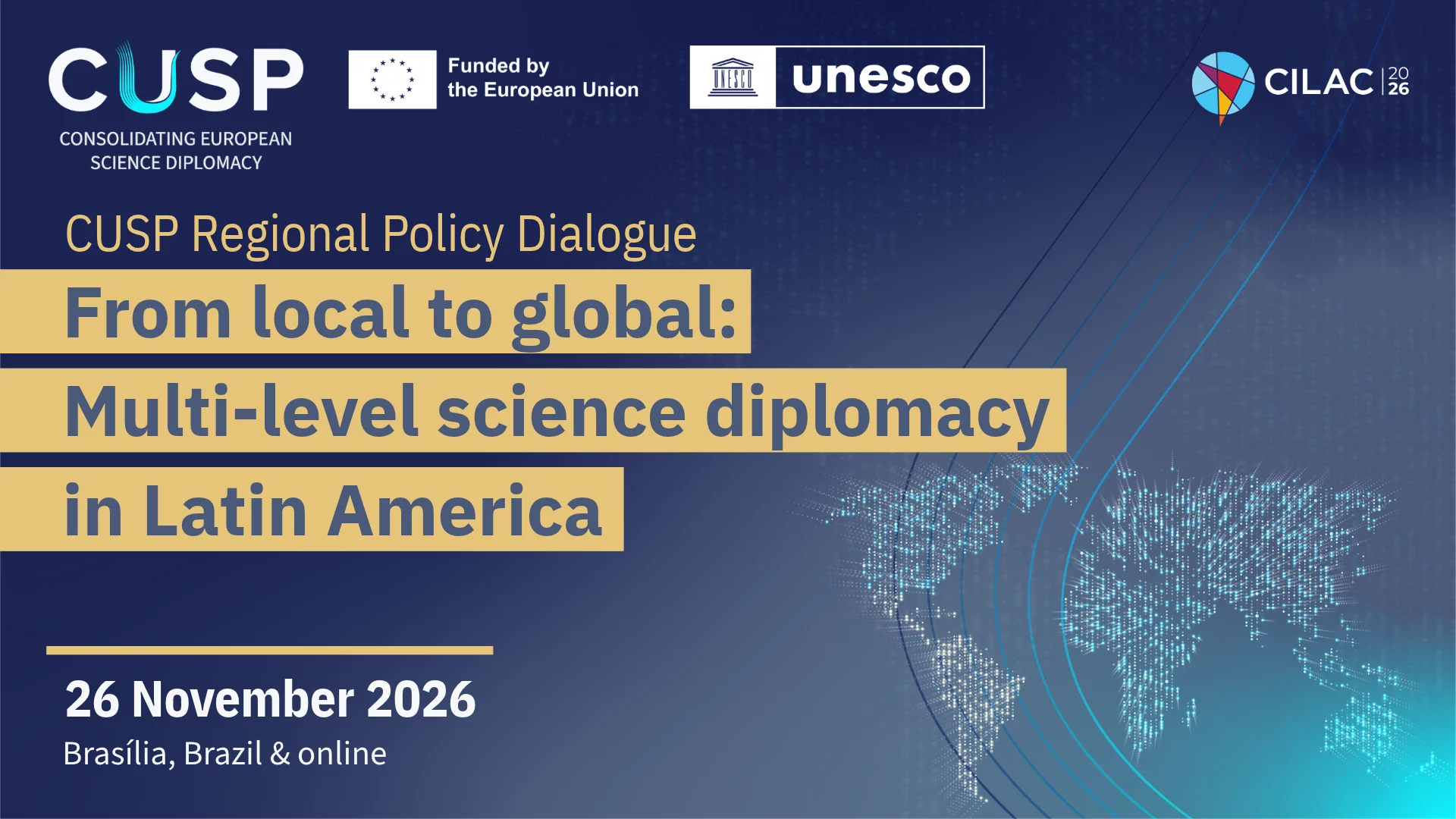
CUSP is organising its first Regional Policy Dialogue at CILAC in Brasília on 26 November 2026. It will bring together Latin American and European Union (EU) science diplomacy leaders in a two-part event: a high-level panel examining science diplomacy in practice from the local to global level, and an interactive workshop aimed at exchanging lessons learned and exploring partnership opportunities.
The high-level panel, titled "From local to global: Multi-level science diplomacy in Latin America", will examine the layers that form science diplomacy practices in the Latin American context. It will bring together contributions from local city–university partnerships, national policy, Ibero-American cooperation, EU–Latin America and the Caribbean (LAC) relations, and global multilateral engagement. It will be moderated by Ernesto Fernandez Polcuch, Regional Director and UNESCO Representative to Argentina, Bolivia, Paraguay and Uruguay.
Key details:
- Date: 26 November 2026
- Time: 09:00–10:30 GMT-03
- Place: Auditorium (Windsor Plaza), Brasília, Brazil
- Interpretation in English, Portuguese and Spanish
Speakers will address five perspectives:
- At the global level, UNESCO will reflect on what its mandate of fostering peace through scientific collaboration means in a world of increasingly tense geopolitics and ever more complex science, technology, and innovation, while also reflecting on its efforts to bring more inclusive perspectives and resilient partnerships to science diplomacy as part of CUSP.
- At the inter-regional level, Francisco André, EU Ambassador to Brazil, will consider how inter-regional science diplomacy is evolving and reflect on what the recently adopted Council recommendation on a European Union framework for science diplomacy could mean for EU-LAC relations.
- At the regional level, Lorena Larios, Secretary-General for Ibero-American Cooperation at the Ibero-American General Secretariat, will explain the added value of science diplomacy for international cooperation in Ibero-America, considering how to better connect science, international cooperation, and foreign policy.
- At the national level, representatives from Panama, which launched a national Science, Technology and Innovation Diplomacy Strategy in 2018, will share its experience of advancing science diplomacy as a joint effort between the Ministry of Foreign Affairs and the Secretaría Nacional de Ciencia, Tecnología e Innovación (SENACYT).
- At the city and university levels, Virginia Brussa, from Argentina's Universidad Nacional de Rosario, will present the Cultural and Scientific Diplomacy Network (REDiCC), which brings together private-sector actors, governments, and civil society organisations to design and promote alternative instruments for collaboration between cities and universities.
- Connecting research expertise to national and bi-regional levels of science diplomacy, Finland's Higher Education and Science Counsellor for Latin America, Johanna Kivimäki, will share Finland's experience from coordinating the participation of the Finnish research community in the bi-regional EU-Community of Latin American and Caribbean States (CELAC) Research and Innovation dialogue.
CUSP's first Regional Policy Dialogue is organised by CUSP partner UNESCO, with the high-level panel co-organised with the Ibero-American General Secretariat (SEGIB), Panama's Ministry of Foreign Affairs, SENACYT (Secretaría Nacional de Ciencia, Tecnología e Innovación), and Argentina's Universidad Nacional de Rosario.
This session is part of a series of regional policy dialogues organised by CUSP, focusing on Latin America, Asia, and Africa, to accelerate policy development beyond Europe and to guide the formation of new science diplomacy partnerships and programmes.
Side-event: Interactive workshop on pathways for science diplomacy in Latin America and the Caribbean
Register for the workshop. Participants must be registered for CILAC to attend the workshop.
As part of CUSP's first Regional Policy Dialogue, an interactive workshop will also take place at the margins of CILAC in the afternoon following the high-level panel, at 16:00 GMT-03. The working language will be English. The workshop will seek to deepen the exchange on equitable science diplomacy partnerships in three priority areas:
- Shared research and data infrastructures
- AI governance
- Biodiversity stewardship
- Science advice for foreign policy
The workshop is open to all participants registered for CILAC, providing a space for policymakers, academics, diplomats, and other stakeholders from LAC, the EU, and other regions to share lessons learned, best practices, challenges, and new ideas. It is organised by UNESCO, as the leader of CUSP's Work Package 5, in partnership with the Brazilian Ministry of Science, Technology and Innovation (MCTI).